Geological Fragility & The "Dying Town"
Civita di Bagnoregio sits majestically upon an unstable plateau of volcanic friable tufa sitting over softer clay strata. Continuous erosion by wind, rain, and the Rio Chiaro river has slowly worn away the cliff edges for centuries, causing outer palaces and defensive gates to tumble into the gorge below—earning it the poetic moniker "La Città che Muore" (The Dying City) from Italian writer Bonaventura Tecchi.
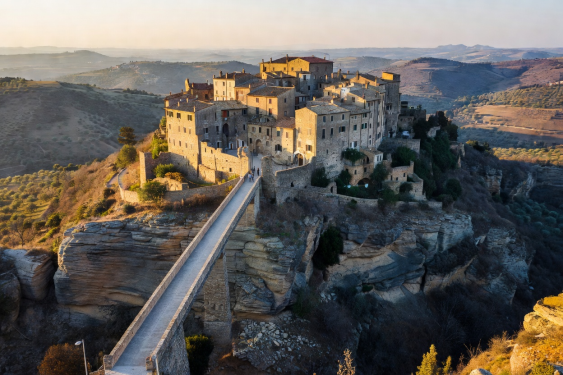
Today, the town is entirely car-free. All provisions, restoration mortar, and artisan goods are transported up the steep concrete footbridge on small motorized carts, ensuring that the peaceful medieval rhythm within the village ramparts remains undisturbed.
Etruscan Necropolises & Renaissance Palaces
Underneath the cobbled Piazza San Donato and centuries-old stone residences lies an extensive network of ancient Etruscan cisterns, wine cellars, and subterranean olive presses hollowed directly into the volcanic rock. During the Roman and Medieval eras, these subterranean rooms served as grain silos, shelters during regional sieges, and cool cellars for aging Pecorino cheese.
Field Notes: What to See & Travel Practicalities
1. Porta Santa Maria (Porta Cava)
The only remaining gateway into the citadel, carved originally by the Etruscans and reinforced in the 12th century with Romanesque archways bearing bas-relief lions grasping human heads, celebrating a historic civic victory over the Monaldeschi tyrants.
2. Piazza San Donato & Romanesque Bell Tower
The beating heart of the village, paved in terracotta and volcanic stones, featuring the 13th-century church with its wooden crucifix attributed to the school of Donatello.