Monograph & Geographic Setting
Compressed horizontally onto a razor-thin strip of land between the Plassen mountain massif and the deep, glass-still waters of Hallstätter See, Hallstatt represents one of the most improbable human settlements in Central Europe. For millennia before modern road tunnels were blasted through the sheer rock in 1890, the village was accessible exclusively by boat or by carrying heavy pack frames across perilous high alpine mountain passes.
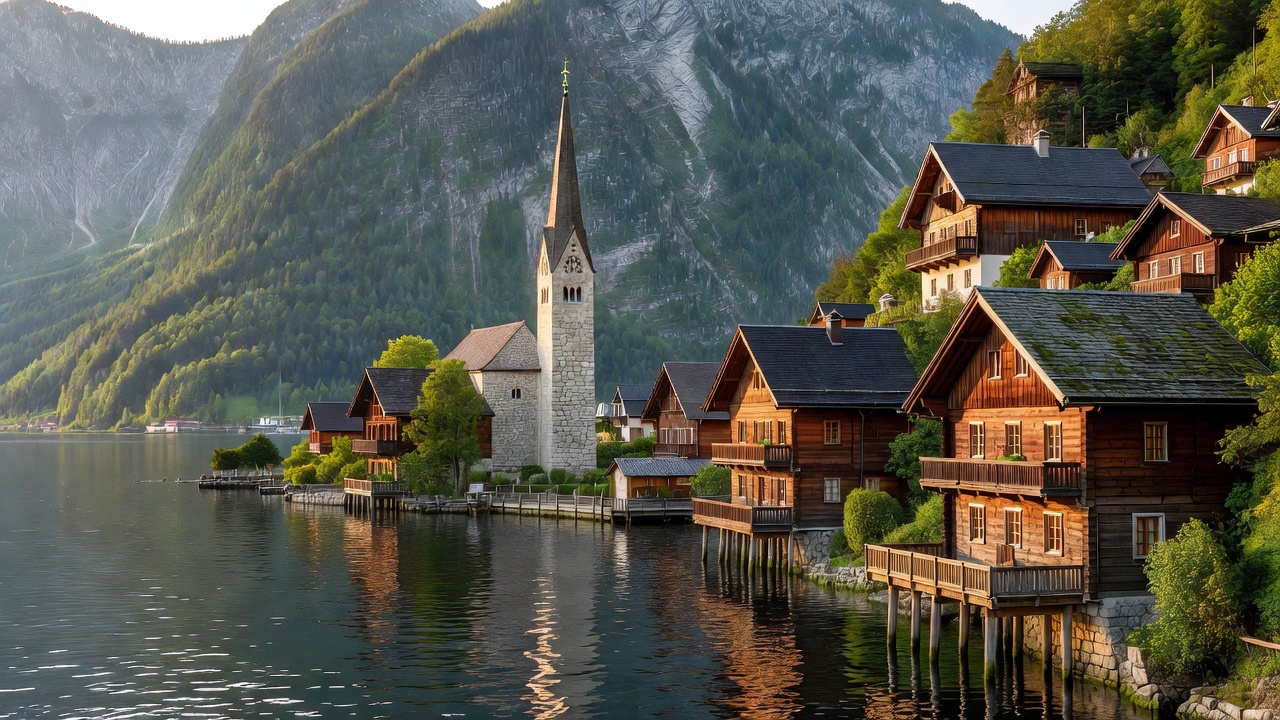
Because of this spatial constraint, houses were stacked directly on top of one another along the steep incline, with top floor entrances often leading into the hillside garden and ground floor cellars opening onto the water. Narrow alleyways and wooden covered staircases (like the famed Mühlbach stairs) form the pedestrian veins of the settlement.
The 7,000-Year Salt Empire (Salzwelten)
The history of European civilization is inextricably bound to the salt deposits preserved deep within the Hallstatt high valley (Salzberg). Known to ancient miners as "White Gold," subterranean rock salt allowed for the preservation of meats and provisions over long continental migrations.
The Hallstatt Culture (800–450 BC)
Archaeological digs initiated by mining director Johann Georg Ramsauer in 1846 unearthed over 1,000 prehistoric graves containing ornate bronze cauldrons, iron daggers, Baltic amber, and ivory. These findings were so rich and culturally unified that archaeologists named an entire prehistoric period—the Hallstatt Culture (Early Iron Age in Europe)—after this tiny Austrian hamlet.
Today, travelers can ride the Salzberg funicular up to the prehistoric mines to tour subterranean brine tunnels, view the oldest preserved wooden staircase in Europe (dated to 1344 BC via dendrochronology), and experience the underground salt lake.
Living Traditions: The Beinhaus & Woodcarving
Due to the acute shortage of burial space in the steep village graveyard, Hallstatt developed a unique mortuary tradition. In the 12th-century St. Michael’s Chapel sits the Hallstatt Beinhaus (Charnel House), housing over 600 decoratively painted human skulls. Relatives would exhume bones after 10–15 years, bleach them in the alpine sun, and paint floral motifs (ivy for life, oak leaves for glory) alongside the deceased's name and year of passing.
Field Guide: Recommended Walking Trails
1. Echerntal Painter’s Trail (Malerweg)
A serene 5.5-kilometer loop passing the Schleierfall cascade and giant glacial potholes (Gletschergarten) carved during the last Ice Age. This trail was celebrated by 19th-century Romantic painters like Ferdinand Georg Waldmüller.
2. The Soleweg (Brine Pipeline Path)
Dating back to 1595, this trail follows the route of the world's oldest active industrial pipeline, which carried dissolved salt brine from Hallstatt to the boiling pans in Ebensee.