Gypsum Plaster & The Moorish Taifa of Ibn Razin
Albarracín takes its name from the Berber clan of Banu Razin, who established an independent Islamic taifa kingdom here during the 11th century. Clinging to the sheer red limestone cliffs of the Universal Mountains (Montes Universales), the town's buildings are coated in a distinctive pinkish-red hue derived from locally quarried red gypsum plaster.
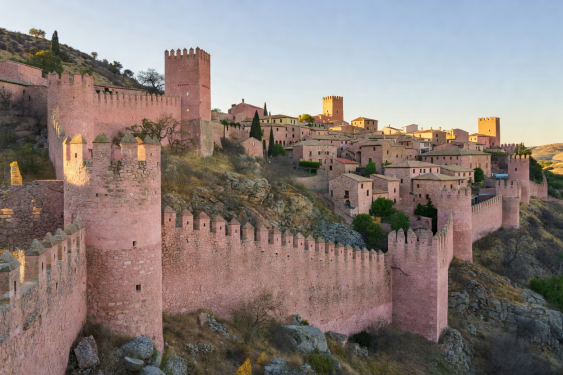
Due to severe spatial constraints within the defensive perimeter, master masons developed dramatic cantilevered timber frames (entramados de madera) and juniper wood overhanging balconies that almost touch across narrow cobblestone alleys (like the famous Casa de la Julianeta).
The Murallas & Mudéjar Architectural Synthesis
Following the Christian Reconquista by the Azagra family in the late 12th century, Albarracín became an autonomous Christian lordship that synthesized Romanesque, Gothic, and Moorish Mudéjar artistic traditions. The grand fortified stone wall (Muralla de Albarracín) snakes dramatically up the ridgeline to the Torre del Andador.
Field Walking Routes & Heritage Points
1. Muralla & Torre del Andador Ridge Walk
A 3.2-kilometer perimeter hike over ancient watchtowers offering a bird’s-eye perspective of the town’s labyrinthine layout and the Guadalaviar river loop.
2. Guadalaviar Riverbed Canyon Trail (Paseo Fluvial)
A wooden boardwalk trail hugging the canyon floor beneath the soaring stone foundations and hanging balconies of the old town.